What do I do with all these dice?
- Oct 10, 2017
- 5 min read
If you've looked into D&D or played it for any amount of time, you've probably figured out that dice play a big roll in determining what happens in the game. For a lot of new players, figuring out what die to roll and when is a bit of a sticking point, and that's what we're going to focus on here.
What dice are for
As I've mentioned before, D&D is a game of near-infinite possibility. However, the game is still grounded by the limitations of your character; otherwise there would be no satisfaction when you actually do accomplish something. So, we roll dice and add the appropriate modifiers (which we'll go over in another post) to determine how well you succeed at a particular action you are attempting. Easy, inconsequential actions like opening unlocked doors, lifting small loads, and taking time to read carefully are all generally free from the need to roll, as it is assumed that you are capable of accomplishing those tasks without particular effort. It wouldn't be a particularly fun game if you were required to constantly check whether you are capable of walking and breathing.
Other actions, like attacking a creature, trying to resist a poison, and attempting to decipher a language you are not familiar with, are all complex enough and carry enough risk of failure to warrant rolling a die to determine whether you succeed or fail the chosen task.
What to roll
Take a look at this picture:

This is an image of a d20. It's called that because it has 20 sides numbered from, you guessed it, 1 to 20.
Look at it closely. Really burn the image into your brain, and make sure you can remember it, because this is the die you will roll for 90% of everything you ever do in D&D.
Want to attack a creature? Roll a D20.
DM wants to see how well you can dodge an arrow coming at you? Roll a D20.
Want to schmooze and NPC, climb a wall, track an animal, or remember something about an area or god? Guess what, you're going to roll a D20 for it.
The D20 remains the subject of so many D&D memes, brands (like Roll20), and stories because it determines almost everything that happens in the game. A good rule of thumb as a new player is to just keep a D20 in hand at all times and assume that whatever you want to do will require rolling it. That said, the D20 can't do all the work.

These little guys are D4s, and they are the small children of the early game. Daggers and other small weapons, low-level Monk punches, small spell buffs (like Guidance), and a few other features are about the only times you'll need these guys.
New players have a bit of trouble understanding how to read what they've rolled; whatever number is upright (the 3 on the black dice in the picture, for example) is the number you have rolled. Some dice have their numbers on the top of the triangle rather than the bottom.

Next up is the D6, the one that just about everyone
has seen before, though you might be more used to ones with dots than numbers.
Mid-sized weapons (shortswords, spears, etc), the damage of many spells, and the health of Wizards and Sorcerers will be determined by this die (the lowest hit die of any class).

Next up is the D8, the mid point of the die scale (excluding the god-king that is the D20). It looks a bit like two D4s stacked end-to-end, and serves about the same purpose.
Mid to high damage weapons (longswords, longbows, etc), a Paladin's Divine Smite attack, and the health of Druids, Warlocks, Clerics, Rogues, Bards, and Monks (pretty obviously the average for hit die) all rely on these guys.

The D10 is where we start getting into the big leagues. Heavy, two-handed weapons (pikes, heavy crossbows), a Monk's Deflect Missile's ability, and the health of Rangers, Paladins, and Fighters all originate from these ten-siders.

The D10 also shares its appearance with the percentage die, shown below. The two are typically rolled together when either a player or the DM needs to determine the percentage of something occurring, or the DM is rolling on a table of 100 or so possible outcomes (very useful for coming up with random loot and encounters). In this case, the D10 determines the 1's place and the percentage die determines the 10's place of the number. Depending on the outcome of the two dice, the 0s on each die can function a little differently.
If the D10 is rolled on its own, the 0 represents a 10, the maximum of that die.
If the percentage die is rolled on its own, the 00 represents 100, the max roll for that die.
If the two are rolled together and the D10 rolls a 0, that roll is considered to be an actual 0, the minimum for the roll.
If the two are rolled together and the percentage die rolls a 00, that roll is considered to be a 0, the minimum for the die, and whatever was rolled by the D10 is the sum total of the roll (i.e. rolling a 00 and a 3 gives a result of 3, since the 10's place is empty).
If the two die are rolled together and the result is a 0 and a 00, the total roll is considered to be 100, the maximum that the two are capable of rolling together.
Feel confused? Don't worry; it's rare that a player will ever be asked to roll for percentage, though some DMs make use of it more than others.

Lastly, at least for the basic set, we have the D12. A bit of a lone wolf, the D12 represents both the maximum die used for abilities and attacks (besides the D20) and the least used one. Ironically, the die finds the greatest use by Barbarians, who are the only class to roll a D12 for health and also have the option to start with a greataxe, the only basic weapon that uses the D12 for damage.
These are all of the basic dice used in D&D, the ones that most orders of dice will include at least 1 copy of to be considered a full set. However, veteran D&D players have found uses for a few other types of dice as well. While I won't go over the uses of each of these dice (partly because this post is long enough as is, and partly because I've never found a legitimate reason to acquire one of them), I will put their names and images below for anyone who sees one and gets curious.
The D3, for when a D4 just isn't small enough.

The D24

The D30.

The D50

The D60
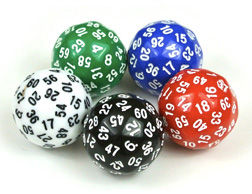
The D100 (the one the might actually be worth getting just to simplify percentage rolling)

And the D120, for when you really just feel like rolling a bowling ball.

There are dozens more dice that have been custom made for various players (D5s, 7s, 9s,16s, and more), but the ones above are about the only ones you're ever likely to run into (and this post has run on long enough). If you're interested in getting some dice, there are some pretty good deals through Amazon if you want to buy single sets or a multi-set. If you plan to dive right in and start your collection of a couple dozen sets (because yes that is a reasonable number of dice to have, and no I don't have a problem), Chessex offers bags by the pound of assorted dice.
P.S. If anyone is wondering why something as simple and useful as a D2 either doesn't exist or I have neglected to cover, it's because the real D2 is something most of us carry around with ourselves every day without even thinking about.


Comments